book description TEXT
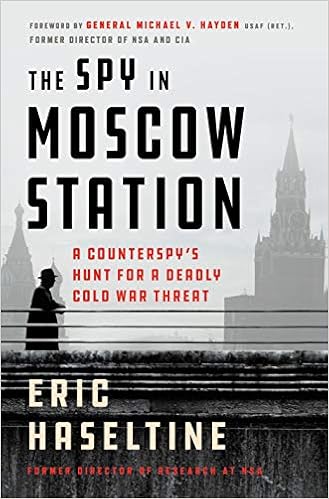
In the late 1970s, the National Security Agency still did not officially exist―those in the know referred to it dryly as the No Such Agency. So why, when NSA engineer Charles Gandy filed for a visa to visit Moscow, did the Russian Foreign Ministry assert with confidence that he was a spy?
Outsmarting honey traps and encroaching deep enough into enemy territory to perform complicated technical investigations, Gandy accomplished his mission in Russia, but discovered more than State and CIA wanted him to know.
REVIEW:
I really enjoyed this book for the history involved, but admit it made for a pretty dry read throughout. This particular infiltration was so technical that it was beyond my comprehension despite the detailed explanations provided. Perhaps a communications expert would get more out of those details – as a reader, I would have preferred a broader overview. I found it all fascinating to be sure, but hard to slog through at times.
Showing posts with label Russia. Show all posts
Tuesday, August 6, 2019
Friday, December 23, 2011
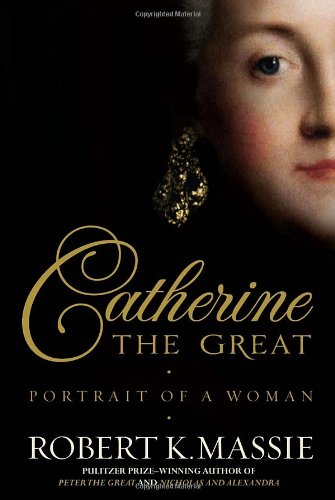
Catherine the Great: Portrait of a Woman by Robert Massey
Book description:
Born into a minor German noble family, Catherine transformed herself into Empress of Russia by sheer determination. Possessing a brilliant mind and an insatiable curiosity as a young woman, she devoured the works of Enlightenment philosophers and, when she reached the throne, attempted to use their principles to guide her rule of the vast and backward Russian empire. She knew or corresponded with the preeminent historical figures of her time: Voltaire, Diderot, Frederick the Great, Empress Maria Theresa of Austria, Marie Antoinette, and, surprisingly, the American naval hero, John Paul Jones.
Reaching the throne fired by Enlightenment philosophy and determined to become the embodiment of the “benevolent despot” idealized by Montesquieu, she found herself always contending with the deeply ingrained realities of Russian life, including serfdom. She persevered, and for thirty-four years the government, foreign policy, cultural development, and welfare of the Russian people were in her hands. She dealt with domestic rebellion, foreign wars, and the tidal wave of political change and violence churned up by the French Revolution that swept across Europe. Her reputation depended entirely on the perspective of the speaker. She was praised by Voltaire as the equal of the greatest of classical philosophers; she was condemned by her enemies, mostly foreign, as “the Messalina of the north.”
Though the heft of this book is daunting when you first pick it up, persevere. It only takes a few pages before you lose track of time and find yourself transported into the past. I read almost half the book in one sitting without even realizing it because the narrative was just so engaging. This is an excellently researched and well-drawn portrait of a truly fascinating woman who transformed herself from a pawn to the Empress of Russia. Massie's writing style is accessible and the characters he reveals through his prose create a deep well of interest and empathy. I knew very little about Catherine the Great before picking up this book, and was stunned by how she seized control of her own destiny to save herself and her adopted country.
Highly recommended, 5 stars.
Born into a minor German noble family, Catherine transformed herself into Empress of Russia by sheer determination. Possessing a brilliant mind and an insatiable curiosity as a young woman, she devoured the works of Enlightenment philosophers and, when she reached the throne, attempted to use their principles to guide her rule of the vast and backward Russian empire. She knew or corresponded with the preeminent historical figures of her time: Voltaire, Diderot, Frederick the Great, Empress Maria Theresa of Austria, Marie Antoinette, and, surprisingly, the American naval hero, John Paul Jones.
Reaching the throne fired by Enlightenment philosophy and determined to become the embodiment of the “benevolent despot” idealized by Montesquieu, she found herself always contending with the deeply ingrained realities of Russian life, including serfdom. She persevered, and for thirty-four years the government, foreign policy, cultural development, and welfare of the Russian people were in her hands. She dealt with domestic rebellion, foreign wars, and the tidal wave of political change and violence churned up by the French Revolution that swept across Europe. Her reputation depended entirely on the perspective of the speaker. She was praised by Voltaire as the equal of the greatest of classical philosophers; she was condemned by her enemies, mostly foreign, as “the Messalina of the north.”
Though the heft of this book is daunting when you first pick it up, persevere. It only takes a few pages before you lose track of time and find yourself transported into the past. I read almost half the book in one sitting without even realizing it because the narrative was just so engaging. This is an excellently researched and well-drawn portrait of a truly fascinating woman who transformed herself from a pawn to the Empress of Russia. Massie's writing style is accessible and the characters he reveals through his prose create a deep well of interest and empathy. I knew very little about Catherine the Great before picking up this book, and was stunned by how she seized control of her own destiny to save herself and her adopted country.
Highly recommended, 5 stars.
Subscribe to:
Posts (Atom)