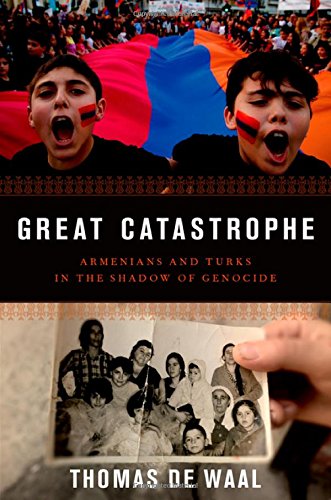
The destruction of the Armenians of the Ottoman Empire in 1915-16 was the greatest atrocity of World War I. Around one million Armenians were killed, and the survivors were scattered across the world. Although it is now a century old, the issue of what most of the world calls the Armenian Genocide of 1915 is still a live and divisive issue that mobilizes Armenians across the world, shapes the identity and politics of modern Turkey, and has consumed the attention of U.S. politicians for years.
In Great Catastrophe, the eminent scholar and reporter Thomas de Waal looks at the aftermath and politics of the Armenian Genocide and tells the story of recent efforts by courageous Armenians, Kurds, and Turks to come to terms with the disaster as Turkey enters a new post-Kemalist era. The story of what happened to the Armenians in 1915-16 is well-known. Here we are told the "history of the history" and the lesser-known story of what happened to Armenians, Kurds, and Turks in the century that followed. De Waal relates how different generations tackled the issue of the "Great Catastrophe" from the 1920s until the failure of the Protocols signed by independent Armenia and Turkey in 2010. Quarrels between diaspora Armenians supporting and opposing the Soviet Union broke into violence and culminated with the murder of an archbishop in 1933. The devising of the word "genocide," the growth of modern identity politics, and the 50th anniversary of the massacres re-energized a new generation of Armenians. In Turkey the issue was initially forgotten, only to return to the political agenda in the context of the Cold War and an outbreak of Armenian terrorism. More recently, Turkey has started to confront its taboos. In an astonishing revival of oral history, the descendants of tens of thousands of "Islamized Armenians," who have been in the shadows since 1915, have begun to reemerge and reclaim their identities.
REVIEW:
This excellent scholarly look at the events surrounding the expulsion of the Armenian population from the Ottoman Empire during WWI makes for a timely and important read given the recent anniversary of the events. This complicated history is pulled apart to explain to a newcomer exactly how the Armenians came to be where they were and how they came to be the victims of such a tragedy. The descriptions of the killings themselves were presented tastefully and with a great deal of humanity. I was fascinated by the author's presentation of the more modern history of the Armenian diaspora and by the debates within in the community surrounding the issue of defining the killings as a genocide. Though I was familiar with the broad outlines of the issue, this book gave me a much deeper understanding of its impact on politics today. This book taught me a lot about a complex question and a politically vibrant diaspora. Highly recommended.
Showing posts with label history. Show all posts
Saturday, April 18, 2015
Wednesday, January 29, 2014
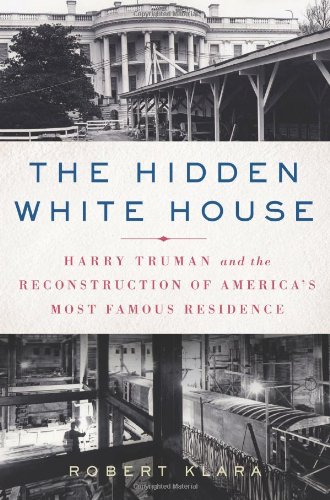
The Hidden White House by Robert Klara
In 1948, President Harry Truman, enjoying a bath on the White House’s second floor, almost plunged through the ceiling of the Blue Room into a tea party for the Daughters of the American Revolution. A handpicked team of the country’s top architects conducted a secret inspection of the troubled mansion and, after discovering it was in imminent danger of collapse, insisted that the First Family be evicted immediately. What followed would be the most historically significant and politically complex home-improvement job in American history. While the Trumans camped across the street at Blair House, Congress debated whether to bulldoze the White House completely, and the Soviets exploded their first atomic bomb, starting the Cold War.
Indefatigable researcher Robert Klara reveals what has, until now, been little understood about this episode: America’s most famous historic home was basically demolished, giving birth to today’s White House. Leaving only the mansion’s facade untouched, workmen gutted everything within, replacing it with a steel frame and a complex labyrinth deep below ground that soon came to include a top-secret nuclear fallout shelter.
The story of Truman’s rebuilding of the White House is a snapshot of postwar America and its first Cold War leader, undertaking a job that changed the centerpiece of the country’s national heritage. The job was by no means perfect, but it was remarkable—and, until now, all but forgotten.
REVIEW:
An informative and delightful look at the 20th century reconstruction of the White House. As a native Washingtonian, I found this wonderful book about the reconstruction of the White House a definite must-read. Full of interesting tidbits about the behind the scenes process of rebuilding the President's residence, this book is both easy to read and a great insight into a little-known element of the history of our nation's capital. Highly recommended for any history buff or presidential scholar-to-be.
Indefatigable researcher Robert Klara reveals what has, until now, been little understood about this episode: America’s most famous historic home was basically demolished, giving birth to today’s White House. Leaving only the mansion’s facade untouched, workmen gutted everything within, replacing it with a steel frame and a complex labyrinth deep below ground that soon came to include a top-secret nuclear fallout shelter.
The story of Truman’s rebuilding of the White House is a snapshot of postwar America and its first Cold War leader, undertaking a job that changed the centerpiece of the country’s national heritage. The job was by no means perfect, but it was remarkable—and, until now, all but forgotten.
REVIEW:
An informative and delightful look at the 20th century reconstruction of the White House. As a native Washingtonian, I found this wonderful book about the reconstruction of the White House a definite must-read. Full of interesting tidbits about the behind the scenes process of rebuilding the President's residence, this book is both easy to read and a great insight into a little-known element of the history of our nation's capital. Highly recommended for any history buff or presidential scholar-to-be.
Labels:
2014,
5 stars,
FCLibrary,
history,
nonfiction,
review,
Washington DC
Tuesday, January 28, 2014
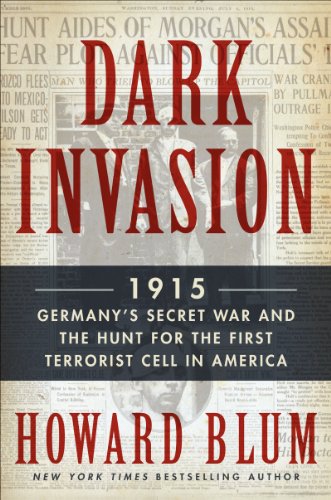
Dark Invasion by Howard Blum
When a “neutral” United States becomes a trading partner for the Allies early in World War I, the Germans implement a secret plan to strike back. A team of saboteurs—including an expert on germ warfare, a Harvard professor, and a brilliant, debonair spymaster—devise a series of “mysterious accidents” using explosives and biological weapons, to bring down vital targets such as ships, factories, livestock, and even captains of industry like J. P. Morgan.
New York Police Inspector Tom Tunney, head of the department’s Bomb Squad, is assigned the difficult mission of stopping them. Assembling a team of loyal operatives, the cunning Irish cop hunts for the conspirators among a population of more than eight million Germans. But the deeper he finds himself in this labyrinth of deception, the more Tunney realizes that the enemy’s plan is far more complex and more dangerous than he suspected.
REVIEW:
This was the first I heard of Germany's secret war against the US before our entry into WWI- what a riveting story! The author used the personalities of those involved (on both sides) to pull the reader into the story. I was fascinated by how much work went into countering this early threat, and by how similar the circumstances and motivations are to those of today's secret warriors. Highly recommended!
New York Police Inspector Tom Tunney, head of the department’s Bomb Squad, is assigned the difficult mission of stopping them. Assembling a team of loyal operatives, the cunning Irish cop hunts for the conspirators among a population of more than eight million Germans. But the deeper he finds himself in this labyrinth of deception, the more Tunney realizes that the enemy’s plan is far more complex and more dangerous than he suspected.
REVIEW:
This was the first I heard of Germany's secret war against the US before our entry into WWI- what a riveting story! The author used the personalities of those involved (on both sides) to pull the reader into the story. I was fascinated by how much work went into countering this early threat, and by how similar the circumstances and motivations are to those of today's secret warriors. Highly recommended!
Friday, January 11, 2013
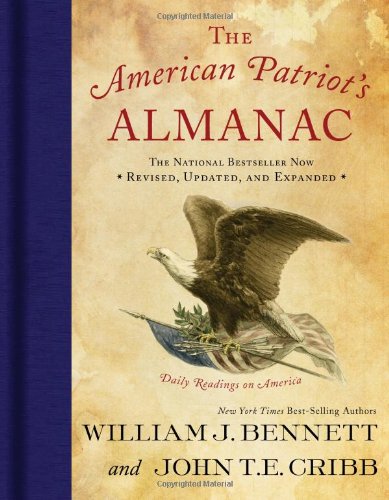
The American Patriot's Almanac: Daily Readings on America by Dr. William J. Bennett & John T.E. Cribb
Book Description:
365 reasons to love America! The fife and drum of history mark the time of each passing day. And within their cadence, personalities, conflicts, discoveries, ideas, and nations peal and fade. American history is no different. From the starving time of Jamestown during the Winter of 1609, through the bloody argument of the Civil War, and to today, the United States is a tale best told one day at a time.
In The American Patriot's Almanac, Bennett distills the American drama into three hundred sixty-five entries-one for each day of the year.
365 reasons to love America! The fife and drum of history mark the time of each passing day. And within their cadence, personalities, conflicts, discoveries, ideas, and nations peal and fade. American history is no different. From the starving time of Jamestown during the Winter of 1609, through the bloody argument of the Civil War, and to today, the United States is a tale best told one day at a time.
In The American Patriot's Almanac, Bennett distills the American drama into three hundred sixty-five entries-one for each day of the year.
Though not the kind of thing you will read through in one sitting, this book is an enjoyable addition to my history shelf. This is the kind of book I pick off a shelf maybe once every couple of weeks and read through for the pleasure of it. I can definitely see how useful it would be for anyone with kids at home because it is a great way to digest small and enjoyable tidbits of American history. This isn't the place to learn all about everything, but this book is a great jumping off point for any student of history. All in all, a thoroughly enjoyable almanac of Americana.
Tuesday, September 20, 2011
A Thousand Lives by Julia Scheeres
Book Description:
In 1954, a pastor named Jim Jones opened a church in Indianapolis called Peoples Temple Full Gospel Church. He was a charismatic preacher with idealistic beliefs, and he quickly filled his pews with an audience eager to hear his sermons on social justice. After Jones moved his church to Northern California in 1965, he became a major player in Northern California politics; he provided vital support in electing friendly political candidates to office, and they in turn offered him a protective shield that kept stories of abuse and fraud out of the papers. Even as Jones’s behavior became erratic and his message more ominous, his followers found it increasingly difficult to pull away from the church. By the time Jones relocated the Peoples Temple a final time to a remote jungle in Guyana and the U.S. Government decided to investigate allegations of abuse and false imprisonment in Jonestown, it was too late.
A Thousand Lives follows the experiences of five Peoples Temple members who went to Jonestown: a middle-class English teacher from Colorado, an elderly African American woman raised in Jim Crow Alabama, a troubled young black man from Oakland, and a working-class father and his teenage son. These people joined Jones’s church for vastly different reasons. Some, such as eighteen-year-old Stanley Clayton, appreciated Jones’s message of racial equality and empowering the dispossessed. Others, like Hyacinth Thrash and her sister Zipporah, were dazzled by his claims of being a faith healer—Hyacinth believed Jones had healed a cancerous tumor in her breast. Edith Roller, a well-educated white progressive, joined Peoples Temple because she wanted to help the less fortunate. Tommy Bogue, a teen, hated Jones’s church, but was forced to attend services—and move to Jonestown—because his parents were members.
Working from recently released documents and tapes seized in Guyana after the mass murder/suicide in Jonestown, Scheeres has created a moving account of the People's Temple by focusing on several individuals who followed Jim Jones (some to their deaths). Scheeres treats this tragedy with acute sensitivity and a remarkable lack of judgmental rhetoric. She clearly spells out how Jim Jones initially drew people to his church and how his message shifted over the years from one of openness and integration to one of megalomania and paranoia. Scheeres also reveals a disturbing lack of action on the part of both the US and Guyanese governments whose dismissive attitude towards Jones' public threats of "revolutionary suicide" helped set the scene for his final solution.
As the narrative wound toward its tragic conclusion, Scheeres did a wonderful job of showing how Jones worked his followers, using drugs, violence, and starvation to keep them compliant and apathetic to his discussions of mass suicide. Scheeres' research makes it clear that Jones had a long range plan to kill all his followers and that he used drugs, threats, and both physical and psychological torture (beatings, sensory deprivation boxes, sleep deprivation, and a constant barrage of Jones' rantings broadcast day and night) to desensitize his followers to that danger. Ultimately, Scheeres did a wonderful job of placing the blame on Jones and on the upper levels of the People's Temple leadership, those who saw Jones unraveling and yet either did nothing or actively abetted his insanity. Using their own words (from interviews with survivors and from journals recovered from Guyana), Scheeres portrays the hundreds who dies in Jonestown as victims, horribly betrayed by a man who, through deception on every level, had gradually taken over every aspect of their lives.
Highly recommended!
In 1954, a pastor named Jim Jones opened a church in Indianapolis called Peoples Temple Full Gospel Church. He was a charismatic preacher with idealistic beliefs, and he quickly filled his pews with an audience eager to hear his sermons on social justice. After Jones moved his church to Northern California in 1965, he became a major player in Northern California politics; he provided vital support in electing friendly political candidates to office, and they in turn offered him a protective shield that kept stories of abuse and fraud out of the papers. Even as Jones’s behavior became erratic and his message more ominous, his followers found it increasingly difficult to pull away from the church. By the time Jones relocated the Peoples Temple a final time to a remote jungle in Guyana and the U.S. Government decided to investigate allegations of abuse and false imprisonment in Jonestown, it was too late.
A Thousand Lives follows the experiences of five Peoples Temple members who went to Jonestown: a middle-class English teacher from Colorado, an elderly African American woman raised in Jim Crow Alabama, a troubled young black man from Oakland, and a working-class father and his teenage son. These people joined Jones’s church for vastly different reasons. Some, such as eighteen-year-old Stanley Clayton, appreciated Jones’s message of racial equality and empowering the dispossessed. Others, like Hyacinth Thrash and her sister Zipporah, were dazzled by his claims of being a faith healer—Hyacinth believed Jones had healed a cancerous tumor in her breast. Edith Roller, a well-educated white progressive, joined Peoples Temple because she wanted to help the less fortunate. Tommy Bogue, a teen, hated Jones’s church, but was forced to attend services—and move to Jonestown—because his parents were members.
Working from recently released documents and tapes seized in Guyana after the mass murder/suicide in Jonestown, Scheeres has created a moving account of the People's Temple by focusing on several individuals who followed Jim Jones (some to their deaths). Scheeres treats this tragedy with acute sensitivity and a remarkable lack of judgmental rhetoric. She clearly spells out how Jim Jones initially drew people to his church and how his message shifted over the years from one of openness and integration to one of megalomania and paranoia. Scheeres also reveals a disturbing lack of action on the part of both the US and Guyanese governments whose dismissive attitude towards Jones' public threats of "revolutionary suicide" helped set the scene for his final solution.
As the narrative wound toward its tragic conclusion, Scheeres did a wonderful job of showing how Jones worked his followers, using drugs, violence, and starvation to keep them compliant and apathetic to his discussions of mass suicide. Scheeres' research makes it clear that Jones had a long range plan to kill all his followers and that he used drugs, threats, and both physical and psychological torture (beatings, sensory deprivation boxes, sleep deprivation, and a constant barrage of Jones' rantings broadcast day and night) to desensitize his followers to that danger. Ultimately, Scheeres did a wonderful job of placing the blame on Jones and on the upper levels of the People's Temple leadership, those who saw Jones unraveling and yet either did nothing or actively abetted his insanity. Using their own words (from interviews with survivors and from journals recovered from Guyana), Scheeres portrays the hundreds who dies in Jonestown as victims, horribly betrayed by a man who, through deception on every level, had gradually taken over every aspect of their lives.
Highly recommended!
Saturday, January 29, 2011
The Island of Lost Maps by Miles Harvey
Book description:The Island of Lost Maps tells the story of a curious crime spree: the theft of scores of valuable centuries-old maps from some of the most prominent research libraries in the United States and Canada. The perpetrator was Gilbert Joseph Bland, Jr., an enigmatic antiques dealer from South Florida, whose cross-country slash-and-dash operation had gone virtually undetected until he was caught in 1995–and was unmasked as the most prolific American map thief in history. As Miles Harvey unravels the mystery of Bland’s life, he maps out the world of cartography and cartographic crime, weaving together a fascinating story of exploration, craftsmanship, villainy, and the lure of the unknown.
It is hard to know what to say about this book which rather defies description. It purports to be about the prolifigate map thief Gilbert Bland, but really Bland's crimes are just the jumping off point for a book about maps, those who made them, and those who covet them. I thought this book would be more similar to The Man Who Loved Books Too Much: The True Story of a Thief, a Detective, and a World of Literary Obsession, but because Bland remained but a shadowy presence, the feel of the two books is completely different. That said, I still found myself pulled into this book and unable to put it down. I can't really explain why I enjoyed it so much, I just did, to the tune of five stars. If you love maps then you are likely to love this book, but if you are looking for a true crime caper, this might not be your cup of tea.
Monday, January 24, 2011
Elizabeth's Women: Friends, Rivals, and Foes Who Shaped the Virgin Queen by Tracy Borman
Book description:So often viewed in her relationships with men, the Virgin Queen is portrayed here as the product of women—the mother she lost so tragically, the female subjects who worshipped her, and the peers and intimates who loved, raised, challenged, and sometimes opposed her.
Borman presents Elizabeth’s bewitching mother, Anne Boleyn, eager to nurture her new child, only to see her taken away and her own life destroyed by damning allegations—which taught Elizabeth never to mix politics and love. Kat Astley, the governess who attended and taught Elizabeth for almost thirty years, invited disaster by encouraging her charge into a dangerous liaison after Henry VIII’s death. Mary Tudor—“Bloody Mary”—envied her younger sister’s popularity and threatened to destroy her altogether. And animosity drove Elizabeth and her cousin Mary Queen of Scots into an intense thirty-year rivalry that could end only in death.
Elizabeth’s Women contains more than an indelible cast of characters. It is an unprecedented account of how the public posture of femininity figured into the English court, the meaning of costume and display, the power of fecundity and flirtation, and how Elizabeth herself—long viewed as the embodiment of feminism—shared popular views of female inferiority and scorned and schemed against her underlings’ marriages and pregnancies.
This is the second Tudor history book I've read this month, and this was by far the more enjoyable. I've read a lot of books (fiction and non-fiction) about Elizabeth but never one like this that focused on the women who surrounded the Virgin Queen and helped shape her views on life and leadership. Though the cast of characters is huge, and many of them share names, Borman did a good job of helping the reader keep track and differentiating between the Janes and Katherines that populated Elizabeth's world. One weakness that I see is that Borman assumes a level of knowledge about the history of the time that makes it clear this book is not for the uninitiated. That said, anyone who has read a couple of books about Elizabeth will have no problem following the action. All in all, an interesting and innovative treatment of a much analyzed figure in history.
Monday, November 8, 2010
Mary Tudor: Princess, Bastard, Queen by Anna Whitelock
Book description:Though often overshadowed by her long-reigning sister, Elizabeth I, Mary lived a life full of defiance, despair, and triumph. Born the daughter of the notorious King Henry VIII and the Spanish Katherine of Aragon, young Mary was a princess in every sense of the word—schooled in regal customs, educated by the best scholars, coveted by European royalty, and betrothed before she had reached the age of three. Yet in a decade’s time, in the wake of King Henry’s break with the pope, she was declared a bastard, disinherited, and demoted from “princess” to “lady.” Ever her deeply devout mother’s daughter, Mary refused to accept her new status or to recognize Henry’s new wife, Anne Boleyn, as queen. The fallout with her father and his counselors nearly destroyed the teenage Mary, who faced imprisonment and even death.
It would be an outright battle for Mary to work herself back into the king’s favor, claim her rightful place in the Tudor line, and ultimately become queen of England, but her coronation would not end her struggles. She flouted the opposition and married Philip of Spain, sought to restore Catholicism to the nation, and fiercely punished the resistance. But beneath her brave and regal exterior was a dependent woman prone to anxiety, whose private traumas of phantom pregnancies, debilitating illnesses, and unrequited love played out in the public glare of the fickle court.
My interest in Tudor history began early- I was booted off a tour of the Tower of London at age 13 for the running commentary I was sharing with my mother! Elizabeth has always been my focus, so I was very excited to see this book on Mary because she is so often treated as only a springboard to Gloriana. Unfortunately, this book just missed the mark for me.
Despite the wealth of information and historical references, this book never made Mary a person to me. The manuscript seemed disjointed, and at times contraditory in its assessment of possible motivations. Quite frankly, the portions about Katharine of Aragon were the most human; her daughter Mary still came off as a cardboard figure throughout the rest of the book.
I appreciated the effort to reveal more about this fascinating woman's story, but was left feeling as disconnected as ever from Mary Tudor. This book is a decent history, but reading it was not a particularly enjoyable experience.
Monday, December 29, 2008
The Last Stand of Fox Company by Bob Drury and Tom Clavin
This remarkable book tells the unbelievable story of a small company of Marines fighting to hold open a mountain pass in Korea. Out-numbered and out-gunned, these 246 Marines hold off 10,000 Chinese soldiers determined to overtake the Toktong Pass near the Choisin Resevoir. The story of their eight day battle is a moving account of bravery and of sacrifice.Drury and Clavin have given the reader a riveting day-by-day picture of the efforts of this extraordinary group of soliders. The narrative is enriched by what are obviously first-hand accounts from the soldiers themselves. The horrors of the days, where the Marines must battle both the elements and the enemy, are meticulously detailed, as are the ever-mounting casualties.
This book is not an easy read by any means, but even knowing the staggering losses that would be presented, I found it hard to put down. Both the writing and the story itself draw the reader in, and make finishing this book an imperative. I highly recommend this book to anyone interested in U.S. military history.
Tuesday, December 23, 2008
The Irish Americans: A History by Jay P. Dolan
If you are looking for a fairly comprehensive look at the contributions of the Irish to American politics and public life, then this is the book for you. A detailed study of the history of prominant Irish Americans, this book is a must-read for any Irish American. The book does read a lot like a college textbook, and I can easily see it being used as such. Despite my high level of interest in the topic, the book was hard to sink into, and certainly required breaks to cleanse the palette. There is a certain amount of repetition which detracted from the reading experience, and I would have appreciated a less dry tone throughout much of the text. Regardless, the book was an excellent effort to record the historical contributions of a powerful minority population in the US, and I would recommend this book to others interested in this history.
Subscribe to:
Posts (Atom)